By Erika | Imperfectly Empowered Coaching BA Psychology | Master’s in Mental Health Counseling (Candidate) | ICF-Certified Insight Strategist | Vocational Specialist
You left. Or you are planning to. And the pressure to land somewhere new, fast, is already building.
From the outside, it makes sense. You need income. You need stability. You need to stop thinking about the job that took everything from you. A new role feels like the logical solution.
Mental health professionals have a name for what happens next. It is the same pattern, different building.
Here is why, and what to do about it.
What a Toxic Workplace Actually Does to Your Decision-Making
When you spend months or years in an environment where your judgment was questioned, your boundaries were ignored, and speaking up led to consequences, something shifts in how your brain operates.
Researchers studying workplace environments have found that prolonged exposure to toxic conditions, including gaslighting, blame culture, and unpredictable leadership, significantly erodes an employee’s confidence in their own perception of reality (Rizvi & Sikand, 2020). You stop trusting what you see. You stop trusting what you know. And eventually, you stop trusting that anything you do will produce a different result.
Mental health professionals call this a form of conditioned helplessness. It describes what happens when a person is repeatedly exposed to situations where their actions do not change the outcome. Over time, the brain stops generating options, not because options do not exist, but because experience has trained it to expect that trying does not work.
This is not a character flaw. It is a predictable psychological response to an unpredictable, harmful environment. And it does not disappear the day you submit your resignation.
The Grief Nobody Talks About
Here is something that surprises most women in this situation. They grieve the job.
Not in the way you grieve something you loved. In a more confusing, harder-to-name way. Psychologist Pauline Boss coined the term ambiguous loss to describe grief that lacks the clear markers of a traditional loss, no funeral, no official ending, no ritual to mark what happened (Boss, 2016). It leads to what she describes as frozen grief: confusion, chronic sorrow, and an inability to move forward because there is no clear resolution.
Leaving a toxic workplace is full of ambiguous loss. You grieve the version of yourself that existed before the environment wore her down. You grieve the career you thought you were building. You grieve the colleagues you trusted before the culture turned them against each other. You grieve the identity you organized your life around, even if that identity was exhausting you.
And here is the part that catches women off guard. That grief does not wait for you to process it. It follows you into the job search. It follows you into interviews. And it quietly shapes every decision you make about what comes next.
Why Desperation Produces the Same Result in a Different Building
When someone is operating from conditioned helplessness and unprocessed ambiguous loss at the same time, the job search becomes a threat response, not a strategic process.
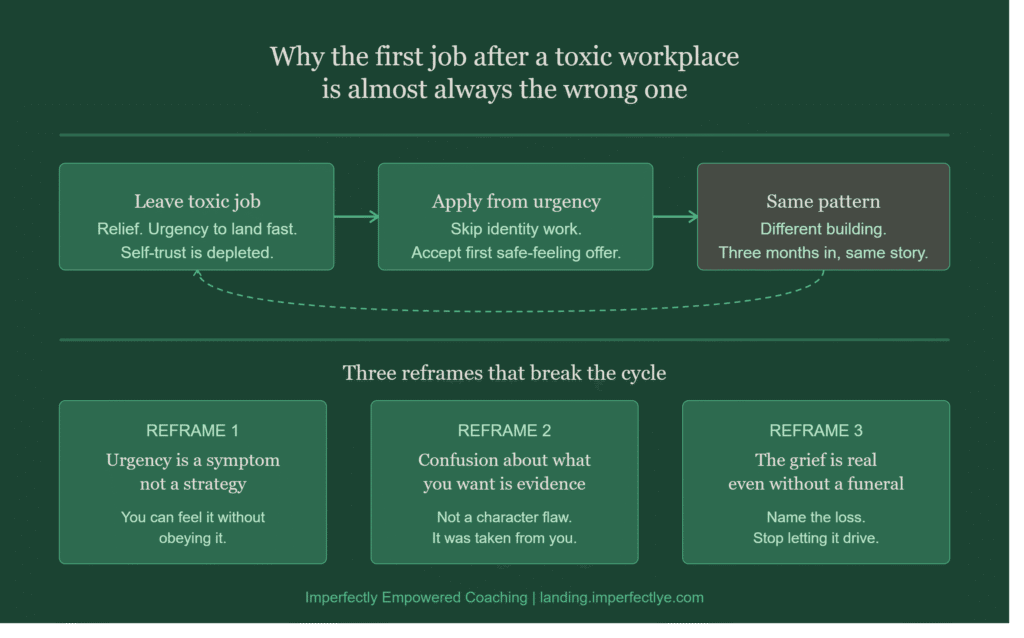
She applies everywhere. She accepts the first offer that does not immediately raise a red flag. She tells herself this one will be different. And three months in, she is sitting in a team meeting watching the same dynamics play out, wondering why she keeps ending up here.
She does not keep ending up here because she has bad judgment. She ends up here because she is making decisions from a depleted, threat-activated state without the tools to screen environments effectively. Research on career transitions confirms that the quality of a career decision is directly linked to the psychological resources available to the person making it (Vough, Bataille, Noh, & Lee, 2015). When those resources are depleted, the decision defaults to urgency and familiarity, not fit and alignment.
Familiarity, in this context, often means another high-pressure environment that mirrors the patterns she already knows how to survive.
Three Mental Health Reframes That Actually Help
Reframe 1: Urgency is a symptom, not a strategy. The pressure to land something fast feels logical because it is financial. But the urgency you feel is also a trauma response. Your system is trying to resolve the threat by escaping it as quickly as possible. Recognizing that urgency as a symptom rather than a directive gives you back some agency in the decision. You can feel the urgency without obeying it.
Reframe 2: Confusion about what you want is not a character flaw. If you spent months or years in a role that required you to suppress your preferences, override your instincts, and perform a version of yourself that fit the environment, of course you do not know what you want. That clarity was systematically removed. The confusion is evidence of what happened to you, not evidence of who you are.
Reframe 3: The grief is real even if nobody around you validates it. You do not need to have loved the job to grieve it. You can grieve a version of yourself, a professional identity, a set of expectations about what your career was supposed to look like. Naming that loss as a real loss, rather than dismissing it as dramatic or ungrateful, is the first step toward processing it in a way that stops it from driving your next decision.
A Grounding Practice for When the Urgency Spikes
When the pressure to just take something becomes overwhelming, try this before opening a job board.
Place both feet flat on the floor. Take a slow breath in for four counts, hold for four, out for six. Do this three times.
Then ask yourself one question: Am I making this decision from clarity or from urgency?
You do not have to have the answer immediately. The practice is in learning to pause long enough to tell the difference. That pause is where your judgment starts coming back.
What the Research Points To
Three sources worth knowing:
Rizvi, Y. S., & Sikand, R. (2020). Learned helplessness at the workplace and its impact on work involvement. This research documents how toxic workplace conditions directly erode self-trust and motivation, making it harder for employees to take effective action even after leaving the environment.
Boss, P. (2016). Ambiguous loss theory: Challenges for scholars and practitioners. Boss’s framework for understanding non-death grief is directly applicable to career transitions from harmful environments. The loss of professional identity, workplace community, and career expectations qualifies as ambiguous loss with real clinical implications.
Vough, H., Bataille, C., Noh, S., & Lee, M. (2015). Making sense of different perspectives on career transitions. This research identifies psychological readiness as a key determinant of successful career transitions, noting that decisions made without adequate processing tend to replicate prior patterns.
The Real First Step
The first job after a toxic workplace is not the problem. Skipping the work that needs to happen before the job search is the problem.
That work is not about processing how bad it was indefinitely. It is about building a clear enough picture of your actual values, your real skills, and the specific environments where you thrive, so that your next decision comes from alignment instead of escape.
If you are in the middle of this right now, the Workplace Harm Spectrum Checklist is the place to start. It is free. It identifies which tier of workplace experience you are recovering from and what your realistic recovery timeline looks like before you make another major career decision.
Link in bio.
This article is for educational purposes and does not constitute therapy or clinical treatment.
Erika | Imperfectly Empowered Coaching | landing.imperfectlye.com
References:
- Rizvi, Y. S., & Sikand, R. (2020). Learned helplessness at the workplace and its impact on work involvement. International Journal of Human Resource Management.
- Boss, P. (2016). Ambiguous loss theory: Challenges for scholars and practitioners. Family Relations, 65(1), 557-570.
- Vough, H., Bataille, C., Noh, S., & Lee, M. (2015). Making sense of different perspectives on career transitions. Journal of Vocational Behavior.
- Sari, R. D., & Dudija, N. (2024). The impact of toxic workplace environments on employee productivity: A systematic literature review. International Journal of Science, Technology & Management, 5(4), 878-882.
- Andrieu, C. F. A., et al. (2024). From voice to acquiescent silence over time as learned helplessness. Journal of Work and Organizational Psychology, 40(2), 103-118.